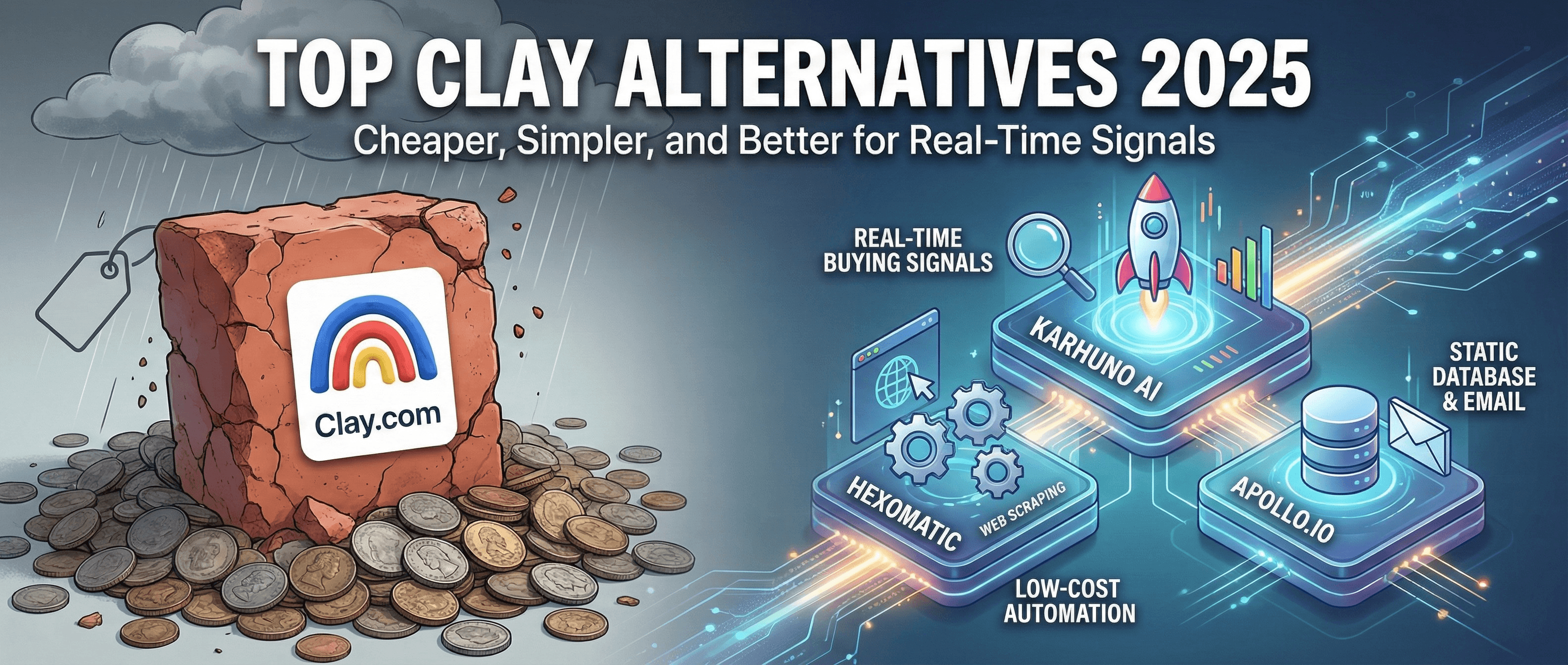
Clay is one of the best automation tools on the market. It is also the wrong tool for a lot of what sales teams actually need.
If you have used Clay for a few months you know the pattern. You upload a list. You enrich it. You build a workflow. Then you wait — because Clay does not tell you which of those accounts are actually in market this week, and it does not find new companies entering your ICP without you uploading them first.
This is the gap most teams hit when they start looking for a Clay alternative.
In 2026 the conversation has shifted. Sales teams care less about "more data" and more about timing: who is hiring right now, who just raised, who opened a new office, who is engaging with a competitor's post. Clay does not surface any of this natively.
This is a practical comparison of the strongest Clay alternatives, what they actually do well, and where they fall short. No marketing fluff. If you are also evaluating database tools, see buying signal intelligence vs contact databases.
Why Teams Are Looking for a Clay Alternative
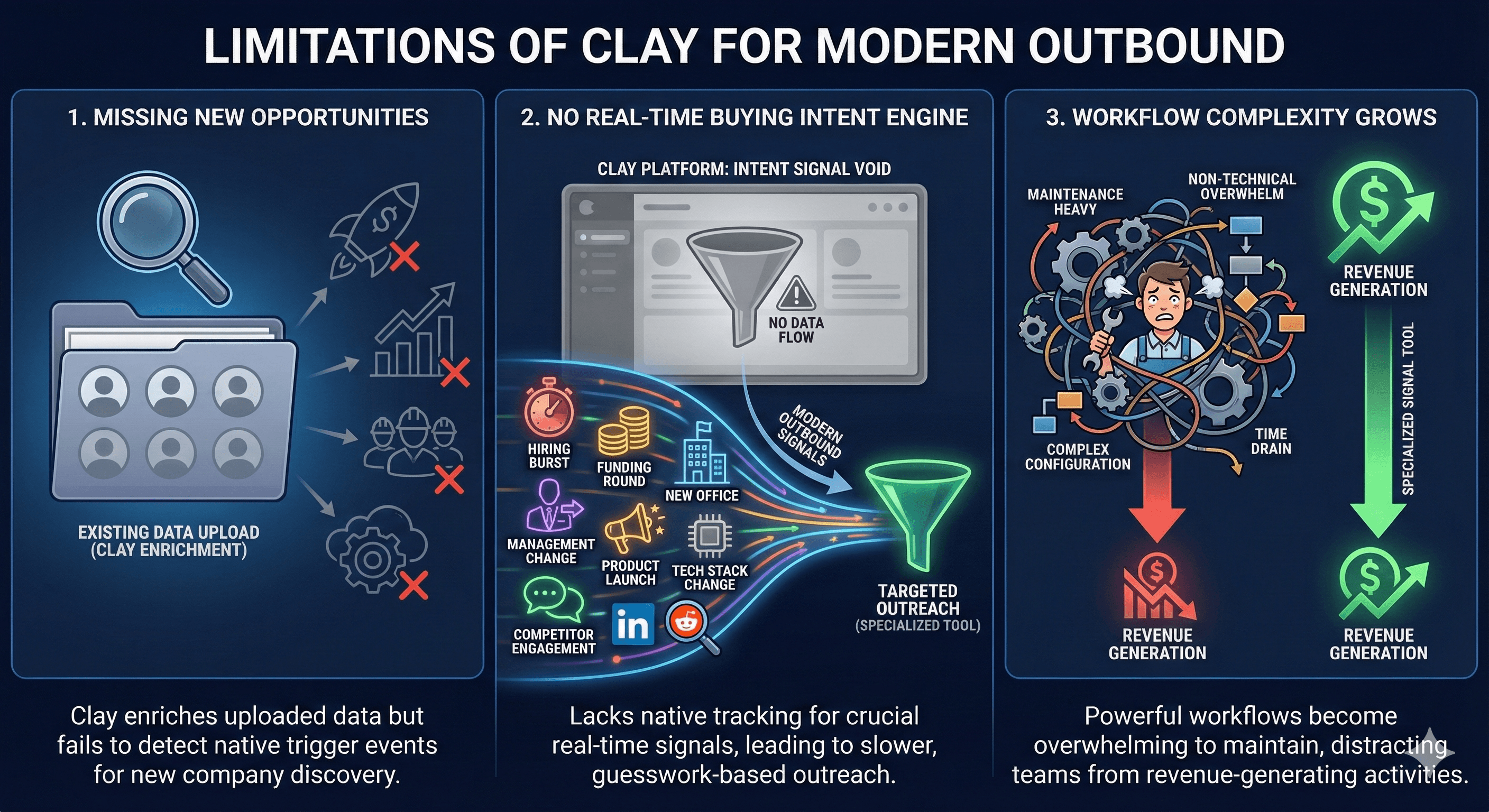
The search for a Clay alternative usually comes down to three frustrations we hear from outbound teams.
Some teams aren't looking for a Clay replacement at all — they're looking for the layer Clay is missing. Others want a full replacement because the workflow maintenance stopped being worth it. This guide covers both cases.
Clay does not find new companies
Clay enriches what you already give it. That works if you already have a strong list-building process. If you do not — and most teams do not — you are stuck doing the manual prospecting Clay was supposed to remove from your workflow.
The companies that matter most for outbound are usually the ones doing something right now: hiring SDRs, opening warehouses, raising capital, adopting a new tech stack, expanding into a new region. Clay cannot detect any of this on its own.
There is no real-time intent layer
Modern outbound runs on signals. Hiring bursts. Funding rounds. New office openings. Leadership changes. Competitor engagement on LinkedIn. Public conversations on Reddit. Clay does not track any of this. You can build a workflow that scrapes some of it, but you are essentially rebuilding a signal engine inside an enrichment tool. Most ops teams give up halfway through.
Workflows get complex fast
Clay is incredibly powerful — and that is also the problem. After 6 months you end up with 20 workflows that only one person on the team understands. When that person leaves, the whole thing breaks. Non-technical reps end up needing a ticket to ops every time they want a new list.
This is why teams start exploring alternatives. Not because Clay is bad. Because the job has changed.
The 8 Best Clay Alternatives in 2026
1. Karhuno AI — Best for Real-Time Buying Signals
If the gap you are trying to close is timing, Karhuno AI is the closest fit.
Where Clay enriches what you upload, Karhuno discovers companies based on what is happening to them right now. It tracks:
- hiring bursts (especially SDR, RevOps, ops roles)
- funding rounds and grant announcements (including EU programs like PNRR)
- new warehouse, office, or distribution centre openings
- leadership changes (new VP Sales, new CRO, new Head of Ops)
- product launches and tech stack changes
- competitor post engagement on LinkedIn
- LinkedIn keyword conversations
- Reddit discussions in B2B-relevant subreddits
- custom industry triggers you define yourself
The point is not that Karhuno has more data than Clay. It has a different kind of data. Clay tells you about a company. Karhuno tells you when something changed about that company.
Where it wins
- Discovers companies automatically — you do not upload a seed list
- Each signal comes with a source link, so reps can quote it in the email
- Setup is hours, not weeks
- Built for sales teams, not ops engineers
- Predictable pricing (no credit-based pricing surprises)
Where it does not win
- Not a full automation platform — if you want to build complex multi-step workflows with conditional logic across 8 enrichment APIs, Clay is still better
- The signal engine is narrower than a generic scraper — it does what it does well, but it is not a Swiss army knife
Best for:
outbound teams, agencies, growth operators, and founders who care more about when to reach out than about having every data point about an account.
Karhuno starts with a free 7-day trial — no credit card required. After that, plans start at $299/month (Growth 100: 100 deal opportunities per month) or $399/month (Growth 150: 150 opportunities). Enterprise teams with custom signal requirements can book a setup call directly. The platform is built for sales teams, not ops engineers — most users are fully set up within a day.

2. Hexomatic — Best for Pure Automation and Scraping
Hexomatic is the closest match to Clay if what you really liked about Clay was the automation side — not the enrichment.
It does web scraping, workflow automation, and bulk enrichment at a lower price point than Clay. The interface is more visual and arguably easier to pick up for non-technical users.
Where it wins
- Cheaper than Clay for most use cases
- Strong scraping capabilities (LinkedIn, Google Maps, Yellow Pages, etc.)
- Workflow builder is more visual
- Good for one-off data extraction projects
Where it does not win
- No buying signal engine — same gap as Clay
- No automatic company discovery
- B2B contact data quality is below Clay and Apollo
- Less integrated with the sales stack (CRMs, sequencers)
Best for:
ops teams running scraping projects, agencies that need flexible automation without paying Clay prices, and anyone whose main need is getting data out of websites rather than finding accounts to call.
If you are switching from Clay specifically to save money on automation, Hexomatic is the obvious move. If you are switching to fix the signal gap, it does not solve that problem either.
3. Apollo.io — Best for Database Volume
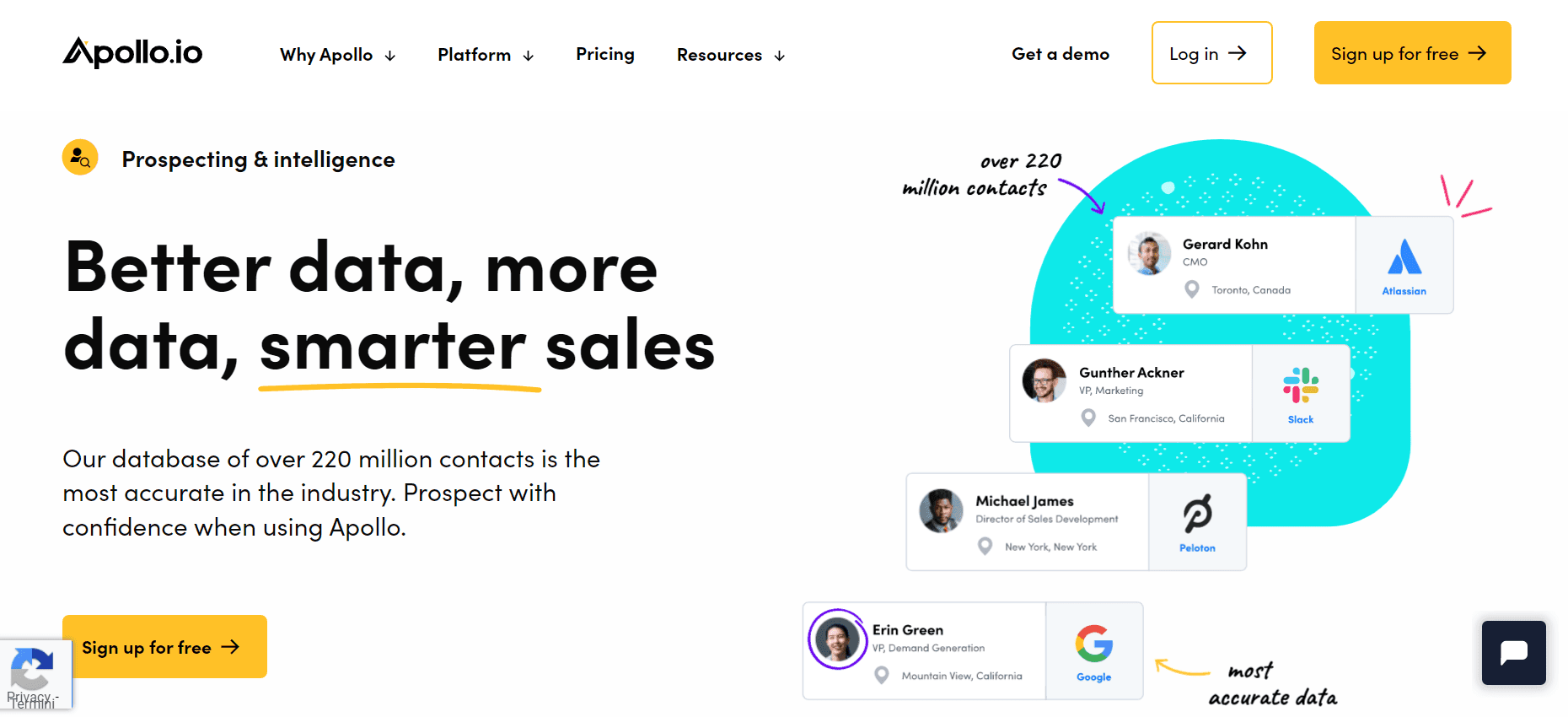
Apollo is the most well-known name in the B2B contact database space. It has millions of contacts, built-in email sequencing, a decent Chrome extension, and tight integrations with most CRMs.
People often pit Apollo against Clay, but they solve different problems. Apollo is a database with outbound tools attached. Clay is an enrichment and automation layer that sits on top of databases.
Where it wins
- Massive contact database (270M+ contacts)
- Built-in email sequencing — no need for Outreach or Salesloft
- Chrome extension is genuinely useful for ad-hoc prospecting
- Free tier is generous
- Strong filtering for ICP building
Where it does not win
- No real-time signals — the data is current, not triggered
- No automatic discovery beyond filter-based search
- Contact data quality varies a lot by region (US is strong, EU is weaker, especially DACH and Southern Europe)
- Email deliverability when sending through Apollo's sequencer is mixed
Best for:
teams that want a single tool for database + sequencer, especially in the US. Less useful for European outbound where data freshness varies and where signal-based timing usually outperforms volume-based blast outreach.
4. Cognism — Best for GDPR-Compliant European Data
Cognism is the go-to B2B data provider for European outbound teams, particularly in the UK, DACH, and Southern Europe where Apollo's data quality drops significantly. It focuses on phone-verified mobile numbers and GDPR-compliant contacts.
Where it wins
- Phone-verified mobile numbers (Diamond Data)
- Strong GDPR compliance framework
- Best data quality for UK and European markets
- Good CRM integrations (Salesforce, HubSpot, Outreach)
Where it does not win
- No buying signal detection or real-time event tracking
- No workflow automation — pure data
- Pricing is enterprise-tier, not transparent
- No account discovery (you still need to know who to search for)
Best for:
European outbound teams that need reliable phone numbers and GDPR-safe contact data. Often used alongside Karhuno — Karhuno finds which accounts to target and when, Cognism provides the verified contacts to reach.
5. Lusha — Best for Individual Contact Lookup
Lusha sits in the same category as Cognism and Apollo but targets a slightly different user: the individual rep doing ad-hoc prospecting rather than a team running bulk outbound. Its Chrome extension is one of the most widely used in the SDR space.
Where it wins
- Chrome extension is fast and easy to use on LinkedIn
- Free tier is usable (5 credits/month)
- Good for point-of-need contact lookup
- Clean UI, low learning curve
Where it does not win
- No automation, no signals, no discovery
- Credit-based model gets expensive at scale
- Data accuracy varies by region
- Not a replacement for Clay's workflow capabilities
Best for:
Individual reps and small teams doing manual prospecting who need quick contact data without a full platform subscription.
6. Lemlist — Best for Personalized Cold Outreach
Lemlist started as a cold email personalization tool and has expanded into a multichannel outreach platform that includes LinkedIn automation and basic enrichment. It is the most direct competitor to Clay's outreach layer — minus the deep enrichment.
Where it wins
- Image and video personalization at scale ({{firstName}} on screenshots, etc.)
- LinkedIn + email + cold calling in one sequence
- Built-in lemlist Leads database for basic prospecting
- Good deliverability tools (email warm-up included)
Where it does not win
- No buying signal detection — same timing gap as Clay
- Enrichment capabilities are basic vs Clay
- Sequence logic is simpler than dedicated sequencers
- Can feel cluttered if you just want clean outreach
Best for:
Teams that want personalized multichannel sequences without building everything in Clay. Often paired with a signal tool to know when to trigger the sequence.
7. n8n — Best Open-Source Alternative for Custom Workflows
n8n is an open-source workflow automation tool that can replicate most of what Clay does on the automation side — at zero licensing cost if self-hosted. It does not have Clay's enrichment integrations out of the box, but it connects to anything with an API.
Where it wins
- Self-hosted option is free — no per-row or credit costs
- Connects to any API, including custom internal data sources
- Highly flexible logic (conditionals, loops, transformations)
- Active community with pre-built templates
Where it does not win
- Requires technical setup — not for non-technical reps
- No built-in B2B data sources (you bring your own APIs)
- No buying signals or account discovery
- Maintenance falls on your team
Best for:
Technical ops teams and RevOps engineers who want Clay-level automation without Clay's pricing. A common stack: n8n for orchestration, Karhuno for signals, Apollo or Cognism for contact data.
8. Instantly.ai — Best for High-Volume Cold Email
Instantly is a pure cold email platform built for volume. It supports unlimited email accounts, has solid warm-up infrastructure, and is one of the most popular tools for agencies running outbound at scale. It does not try to be Clay — it is the outreach layer that sits after you have found your targets.
Where it wins
- Unlimited sending accounts on paid plans
- Strong warm-up infrastructure built in
- Clean, fast sequence builder
- Uni-inbox for managing replies across accounts
Where it does not win
- No enrichment, no data, no signals
- No LinkedIn automation
- Purely an outreach tool — not a Clay replacement in any other sense
- B2B data add-on (Instantly Leads) is limited
Best for:
Agencies and high-volume senders who need to manage cold email at scale. Works well paired with a discovery tool like Karhuno (for signal-based targeting) and a data tool like Apollo (for contacts).
Clay Competitors Compared: Full Feature Table
| Feature | Clay | Karhuno AI | Hexomatic | Apollo.io | Cognism | Lusha | Lemlist | n8n | Instantly |
|---|---|---|---|---|---|---|---|---|---|
| Workflow automation | ⭐⭐⭐⭐⭐ | ⭐⭐⭐ | ⭐⭐⭐⭐ | ⭐⭐⭐⭐ | ❌ | ❌ | ⭐⭐⭐ | ⭐⭐⭐⭐⭐ | ⭐⭐ |
| Finds new companies | ❌ | ✅ | ❌ | Filters | Filters | Filters | ❌ | ❌ | ❌ |
| Real-time buying signals | ❌ | ✅ | ❌ | ❌ | ❌ | ❌ | ❌ | ❌ | ❌ |
| Contact database | Via partners | Via partners | ❌ | ✅ | ✅ | ✅ | Basic | ❌ | Basic |
| Built-in sequencer | ❌ | ❌ | ❌ | ✅ | ❌ | ❌ | ✅ | ❌ | ✅ |
| EU data quality | Medium | High | Low | Medium | High | Medium | Medium | — | — |
| Free tier | Limited | 7-day trial | ✅ | ✅ | ❌ | 5 credits | Limited | ✅ | Limited |
| Best fit | Power ops | Signal-first outbound | Scraping | US database | EU data | Contact lookup | Personalized outreach | Custom automation | Volume email |
What B2B Buying Signals Actually Look Like
This is worth a separate section because most articles skip it and the term gets used loosely.
A buying signal is a visible event that suggests a company is entering — or already inside — a decision window for something you sell.
Real examples:
- A logistics company posts 4 SDR roles in a week. They are probably scaling outbound and need tooling.
- A SaaS company announces a Series A led by a US fund and mentions DACH expansion. They will hire local sales reps and need market intelligence in regions they do not know yet.
- A manufacturer publishes a press release about a new 14,000m² distribution centre. They need a WMS, automation review, and possibly facility services.
- A prospect engages with a competitor's LinkedIn post about a topic in your category. They are actively aware of the problem space.
- A founder posts on Reddit asking how others solved a problem your product addresses. The intent is explicit.
These signals create concrete reasons to reach out now. They also give the rep something specific to reference in the first line of the email — which is the single biggest predictor of cold email reply rates. This is the layer Clay does not cover. Karhuno is built specifically for this.
Why European B2B Teams Hit This Gap Harder
The timing problem Clay leaves open gets worse the further you go into European markets.
Clay's enrichment partners have decent US coverage. Run a list of German 3PLs, Dutch manufacturers, or Polish logistics firms through those same pipelines and the data gets sparse fast. The underlying networks are US-centric — they do not read regional business press, national tender portals, or hiring posts written in German or French.
A signal layer solves a different problem than enrichment. Clay fills in what you already have. A signal layer tells you which accounts just entered a buying window — before you have a list at all. For European markets those signals live in sources most tools never touch: facility permit filings, local logistics press, EU funding announcements, TED tender entries.
If your ICP is in DACH, Benelux, the Nordics, or Southern Europe, see how a B2B intent data platform built for Europe approaches discovery differently from US-built enrichment stacks.
Which Clay Alternative Should You Choose?
Quick guide:
- You want timing and a reason to reach out now → Karhuno AI. The signal engine is what makes the difference.
- You want cheap automation and scraping → Hexomatic.
- You want a database with a sequencer attached, especially in the US → Apollo.io.
- You need GDPR-compliant European data with verified mobile numbers → Cognism.
- You want quick contact lookup for individual reps → Lusha.
- You want personalized multichannel sequences without the complexity of Clay → Lemlist.
- You are technical and want full automation flexibility for free → n8n (self-hosted).
- You run high-volume cold email at agency scale → Instantly.ai.
- You want full automation flexibility and have an ops engineer who likes maintaining workflows → stay on Clay. It is still the best at what it does.
The honest answer is that most teams end up using two tools, not one. Karhuno for discovery and timing, Apollo or Cognism for contact enrichment, and Instantly or Lemlist for the outreach layer. Or Clay for complex enrichment workflows, Karhuno for the signal layer Clay does not cover.
How to Try Karhuno
Karhuno starts with a free 7-day trial — no credit card required. You get full access to set up signal tracking for your specific ICP and see real buying signals coming in before you commit to anything. After the trial, plans start at $299/month (Growth 100: 100 deal opportunities per month) or $399/month (Growth 150: 150 opportunities).
For enterprise teams with custom signal requirements, we offer a setup call to configure tracking specific to your category, region, and ICP. The difference between a noisy signal feed and one that drives meetings is the setup — what to track, what to ignore, which triggers map to a real buying window. That is what the onboarding covers.
If you are evaluating Clay alternatives because you keep running into the same gap (no timing, no discovery, no real signals), the trial is the fastest way to find out whether signal-based outbound is actually different for your specific market.
FAQ: Clay Alternatives
- What is the best Clay alternative?
- It depends on what gap you are trying to close. For real-time buying signals and automatic account discovery, Karhuno AI is the closest fit. For cheap automation and scraping, Hexomatic. For a contact database with built-in sequencer, Apollo.io.
- What is Clay used for?
- Clay is an enrichment and automation platform. Teams use it to combine data from multiple sources, build lead lists, run waterfall enrichment, and automate outbound workflows. It does not find new accounts on its own and does not track buying signals.
- Is there a free Clay alternative?
- Apollo.io has a generous free tier with limited credits. Hexomatic has a free tier limited to small workflows. n8n is free if self-hosted. Lusha offers 5 free credits per month. Karhuno AI offers a free 7-day trial with no credit card required. After the trial, plans start at $299/month (Growth 100). The setup is guided — signal-based outbound works best when someone helps you define the right triggers for your specific ICP.
- Why are sales teams switching from Clay in 2026?
- The most common reasons: Clay does not discover new accounts, does not track real-time buying signals, and workflows become complex to maintain over time. Teams that need timing-based outbound usually add a signal tool like Karhuno alongside or instead of Clay.
- Can Clay detect buying signals?
- Not natively. Clay can scrape some signal sources if you build the workflow yourself, but it is not a signal engine. Dedicated tools like Karhuno AI track hiring, funding, expansion, leadership changes, competitor engagement, and social conversations out of the box.
- What is the difference between Clay and Karhuno AI?
- Clay enriches the data you upload. Karhuno discovers new companies based on real-time events — hiring, funding, expansion, competitor engagement — and surfaces them with the source link so reps can act immediately.
- Is there a Clay alternative that works better for European B2B outbound?
- Most Clay alternatives share the same EU data coverage gaps. The stronger setup for European markets pairs an enrichment tool with a signal layer that tracks European public events — regional press, national tender portals, facility filings, local hiring posts across languages. See how B2B intent data platforms built for Europe differ from US-centric enrichment tools.