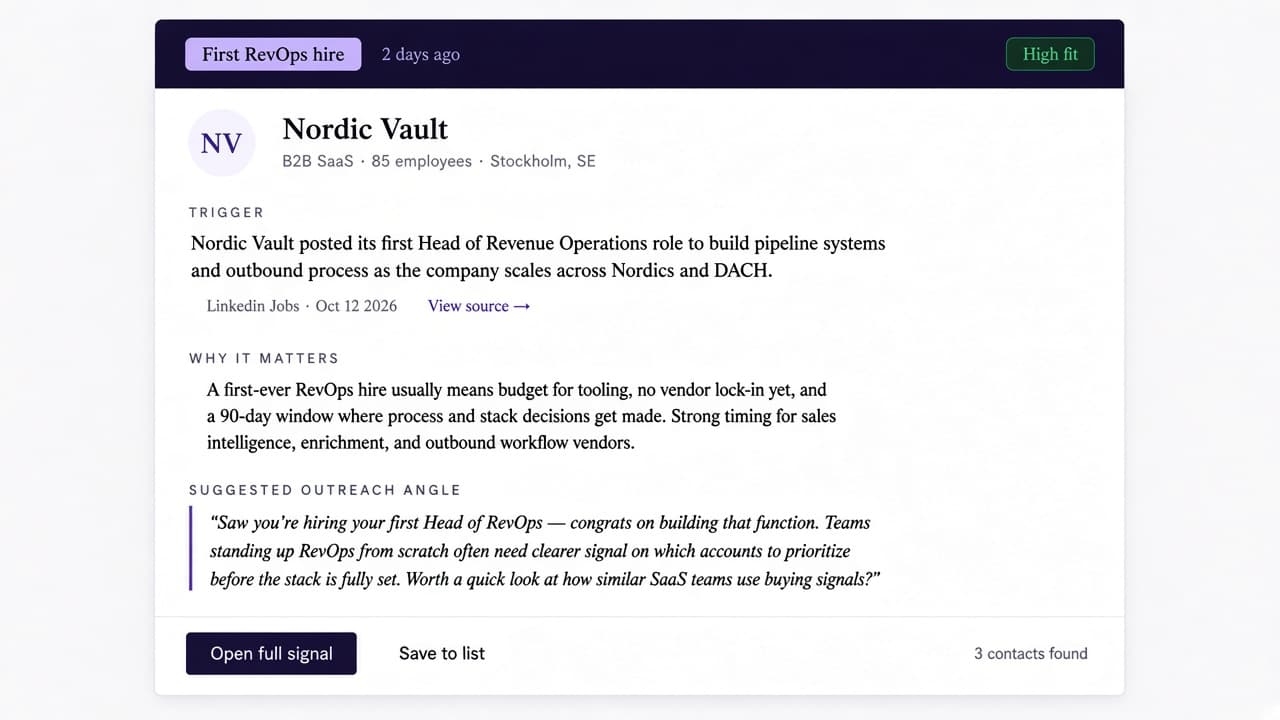
Here's how it usually goes. A team plugs in a signal feed. On Monday there are 40 new accounts: a funding round, three job posts, a new warehouse in Rotterdam. The SDRs drop all 40 into the same sequence they used for cold lists, add "Congrats on the news!" to line one, and wait.
Reply rates go up a little. Then they slide back down, and someone in the pipeline meeting says signals don't work.
Signals work fine. The process around them was built for cold lists. This guide is the process we'd use instead, based on what we see across Karhuno customers in logistics, SaaS, compliance and industrial sales.
What counts as a buying signal (and what's just noise)
A real buying signal has three parts. Miss one and you have trivia, not a reason to call.
- An event you can verify. A press release, a job post, a tender notice, a permit filing. Something with a link.
- A direct line to your product. "They raised money" is weak. "They raised money to open two more distribution centres" is strong if you sell to distribution centres.
- A time window. The event creates a decision that will be made in weeks or months, not someday.
Things that usually fail the test: a company liked a post, someone visited your pricing page once, an account is "surging" on a topic with no event behind it. These can help you rank accounts. They rarely give you anything to say. We went deeper on that gap in why intent scores aren't enough for outreach.
Why timing beats volume
A cold list asks: who could buy from us? A signal asks: who has to make a decision soon? The second group is much smaller. It's also the only group where your message lands while the problem is on their desk.
Take a company that just announced a new 20,000 m² warehouse opening in spring. Between now and then somebody will pick racking, a WMS, a staffing agency, forklifts, security and probably a cleaning contractor. Those vendors get chosen in a few short months. If you write six months after go-live, you're pitching a replacement, which is a much harder sale. Our warehouse signals case study shows a deal that closed in 24 hours because the timing was right.
Small list, right moment, specific message. That's the whole idea. The rest of this article is about doing it without burning the signal.
The 6-step signal-based selling playbook
1.Pick three to five signals that map to your product
Start from the problem you solve and work backwards. What has to happen at a company for that problem to become urgent? Write those events down. That's your signal list.
Keep it short. Teams that track fifteen signal types end up with a feed nobody trusts, because half of it is loosely related. Here's a map you can steal and adapt:
| Signal | What it usually means | Who to contact | Opening angle |
|---|---|---|---|
| New warehouse or DC announced | Racking, WMS, forklifts, staffing and security all get bought in the next few months | Head of logistics, site or operations director | Their go-live date and what usually breaks first |
| Hiring a first-ever role (first CISO, first RevOps lead) | A new function with a budget and no vendors yet | The hiring manager, then the new hire after day 30 | What the first 90 days in that role tend to need |
| Public tender or RFP published | Budget is approved and the spec is written down | Procurement contact named in the tender | A specific requirement in the spec you meet well |
| Funding round with a stated use | Money is earmarked for something you can map to | The exec who owns that stated use | The plan they announced, not the round size |
| Complaint about a competitor's product | Switching cost is suddenly worth paying | The person who posted, or their team lead | The exact issue they named, and how you handle it |
| Certificate or contract about to expire | A renewal decision is coming whether they plan for it or not | Compliance, quality or procurement owner | The date, and what the renewal usually involves |
If you sell security consulting, the compliance rows matter and the warehouse row doesn't. Our guide on finding companies that need ISO 27001 is a full worked example of building a signal list for one niche.
2.Qualify each signal in five minutes
A strong signal at the wrong company is still the wrong company. Before anyone writes a message, run a quick check:
- Does the account fit your ICP on size, region and industry?
- Is there a disqualifier? A competitor just signed a three-year deal, a hiring freeze, layoffs.
- Is the event recent enough that the decision is still open?
- Can you name the person who will own the decision?
If you can't answer the last question, park the account for a week instead of guessing. A message to the wrong person spends the signal for nothing.
3.Find the person the signal is about
Every signal points at a specific job. A new DC points at the operations or site director. A first-ever security hire points at the CTO who opened the role. A funding round with "expanding into Germany" points at whoever was hired to lead DACH.
Don't default to the CEO because the news was on the company page. CEOs of 300-person companies don't choose racking suppliers. Go one or two levels down to the person whose week just got harder because of the event.
4.Write signal, implication, offer
The best signal-based messages have three moves. Name the event in one line. Say what it probably means for them, which is where you show you understand their world. Then offer one small, useful thing.
The congratulations opener skips the middle step, which is the only step that shows expertise.
What most teams send
Hi Anna, congrats on the new warehouse in Venlo! 🎉
We help logistics companies streamline operations with our innovative platform. Would you be open to a quick 15-minute call next week?
What works better
Hi Anna, saw the Venlo site is going live in March.
On new sites that size the slotting plan usually gets rebuilt in the first two months, once real order profiles show up and the original layout doesn't match them.
We put together a short go-live checklist from the last few DC launches we supported. Want me to send it?
The second version is longer and asks for less. It proves you know what happens after a warehouse opens, and the ask is so small it's easy to say yes. For LinkedIn-specific examples, see how one team got 58 positive replies from signal-based LinkedIn outreach.
5.Set follow-ups by signal age, not by sequence day
Cold sequences run on a fixed rhythm: day 1, day 3, day 7, day 14. With signals the clock is the event, not your sequence. A tender closing in 21 days needs three touches in two weeks. A funding round with an 18-month plan can take a slower pace with more useful content between touches.
Also watch for a second signal on the same account. A warehouse announcement followed a month later by a job post for a WMS administrator is a much stronger reason to follow up than "just bumping this."
6.Measure reply rate per signal type
Tag every outreach with the signal that triggered it. After 50 to 100 messages per signal type you'll see clear differences. Some signals will reply at two or three times the rate of others. Some will produce replies that never turn into meetings.
Cut the weakest signal every quarter and test a new one. That keeps the feed tight enough that reps actually read it, which matters more than coverage.
Mistakes that waste good signals
- Sending everyone the same message with a different first line. Prospects can tell when the signal is a mail-merge field and the rest is boilerplate.
- Stacking every signal you found. "I saw you raised a round, hired a CFO, opened an office in Lyon and posted about AI" sounds like surveillance. Pick the one that connects to your offer.
- Waiting for perfect data. A good signal from yesterday with an okay contact beats a perfect contact three weeks after the vendor was picked.
- Making it personal. Stick to company events and public work posts. Referring to someone's private life or a personal post is where signal-based selling gets creepy.
- Leaving signals in the SDR's head. Log the signal in your CRM next to the account. When an AE picks up the deal three weeks later, they should know why the conversation started.
Where signals come from
You can run this playbook by hand. A rep with an hour a day can cover a narrow niche:
- Google Alerts and local news for facility openings and expansions
- Job boards filtered for the roles that indicate a new function
- Tender portals like TED for public procurement in the EU
- LinkedIn posts from your buyers, especially complaints about tools. See our list of 5 LinkedIn buying intent signals
- Company press pages and funding databases
The problem is scale and language. Once you sell across more than one country, half the signals are in German, Dutch, French or Finnish, on local news sites that generic tools don't index well. That's the gap we built Karhuno for.
Karhuno watches the web, LinkedIn, tenders and local news for the signal types you define, checks each event against your ICP and disqualifiers, and delivers the company with the source link, account context and the right contact attached. You get steps 1 to 3 of this playbook done before you open the feed, and can spend the time on step 4, which is the part that actually needs a human.
Plans start at $299/month for 100 deal opportunities, with a 7-day free trial so you can test it on your own market first. If you're selling into Europe, our page on intent data for European B2B covers the regional side.
FAQ
- What is signal-based selling?
- Signal-based selling means you reach out to a company because something just happened there that connects to what you sell: a new facility, a hire in a buyer role, a tender, a funding round with a stated use. The signal decides who you contact and when, and it gives you the first line of the message.
- What's the difference between a buying signal and intent data?
- Intent data usually tells you an account is reading about a topic. A buying signal is a concrete, verifiable event with a source you can point to. Intent scores help you rank accounts. Signals give you a reason to write today and something specific to say.
- How fast should I reach out after a buying signal?
- For strong signals like a facility opening or a new head of a buying function, within a few days. The window closes when vendors get shortlisted, and the first relevant message has a clear advantage over the fifth one.
- Should I mention the signal in my outreach?
- Yes, if it's public and work-related, like a press release, a job post, or a company announcement. Mention it in one line and move straight to what it probably means for them. Skip anything that feels like you were watching a person rather than a company.
- How many signal types should a team track?
- Start with three to five that map directly to the problem you solve. More signal types usually means more noise, and reps stop trusting the feed. Add new ones only after you've measured reply rates on the first set.