What intent data actually measures
Intent data comes in three flavours, and they are not equally useful.
- First-party intent. Behaviour on your own properties: pricing page visits, demo page views, webinar sign-ups, product usage. It is the most reliable kind because you collect it and can see the details.
- Second-party intent. Another company's first-party data, shared or sold to you. Review platforms are the common example: someone at an account compared vendors in your category.
- Third-party intent. Research activity collected across publisher networks and other sources, matched to companies and sold as topic surges or account scores. This is what most people mean by "intent data".
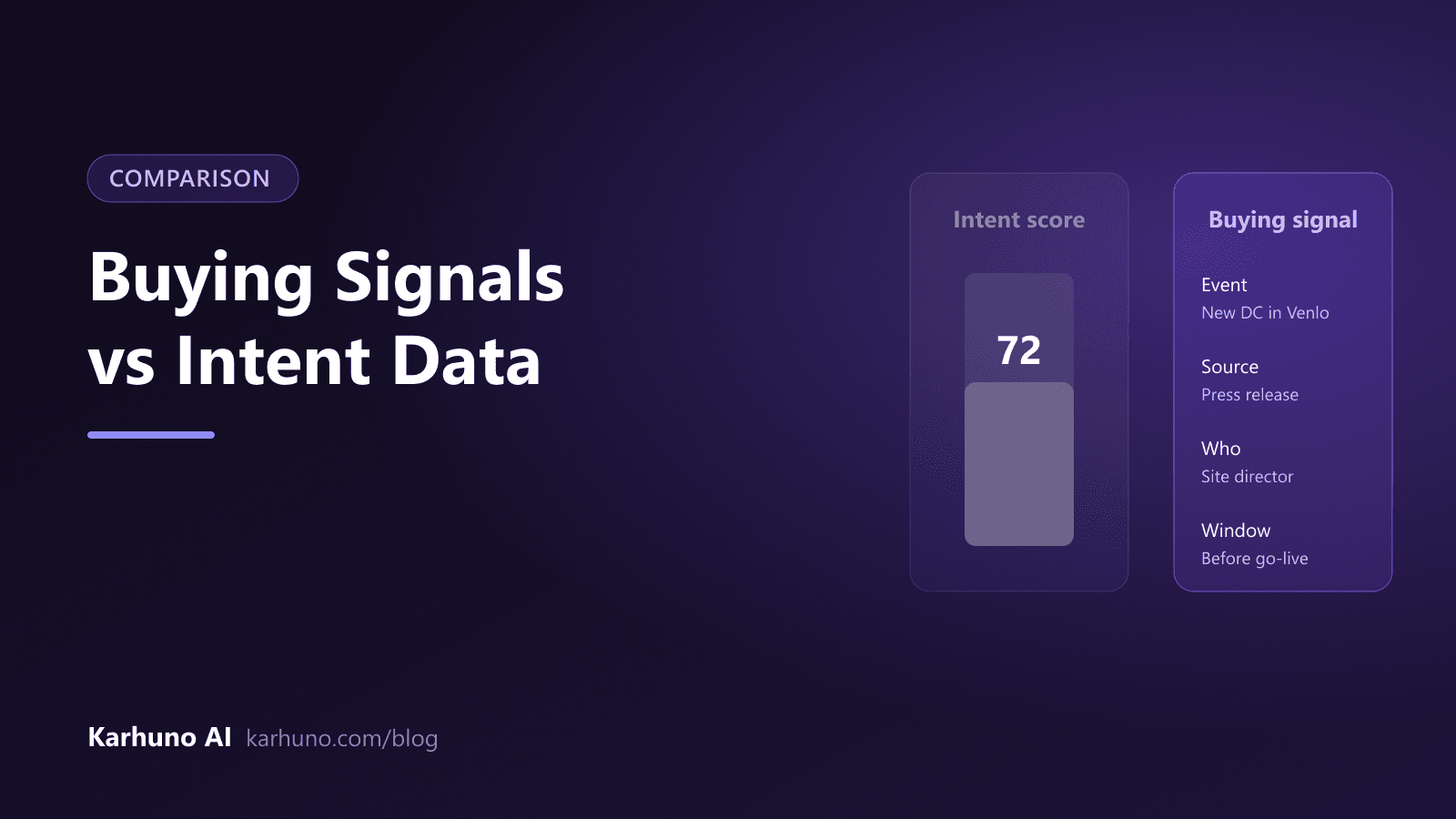
Third-party intent works by spotting that people at an account consume more content on a topic than their usual baseline. The provider maps that activity to a company, compares it to the norm and outputs a number. That compression is the strength and the weakness: you can rank thousands of accounts at once, but you lose the story behind the number.
What a buying signal measures
A buying signal starts from an event, not from behaviour. Something happened at the company that creates a need: a warehouse is opening in March, a first CISO started last month, a certificate expires in the spring, a tender closes in three weeks. You can link to it, date it and name the person likely to own the decision.
That makes signals harder to collect at scale. They are scattered across news sites, job boards, tender portals, registries and social posts, often in local languages. But once you have one, it does most of the outreach work for you. Our list of 40 B2B buying signals by industry shows the range.
Side by side
| Intent data | Buying signals | |
|---|---|---|
| Starts from | Research behaviour | An event at the company |
| Output | Score or topic surge per account | Event, source, context and contacts |
| Can you verify it? | Rarely; the activity behind the score is hidden | Yes, there is a link and a date |
| Tells you why | No, only that interest rose | Yes, the event is the reason |
| Tells you who | Usually not; activity is matched at account level | Usually; the event points to a role |
| Tells you when | Roughly, while the surge lasts | Often precisely: before go-live, before a deadline |
| Coverage | Broad, thousands of accounts | Narrower, only accounts where something happened |
| Best for | Ranking, ads, account selection | Outbound timing and the first message |
Where intent data works well
Intent data is not useless. It is often used for the wrong job.
- Ranking a big target list. If you have 5,000 ICP accounts and capacity for 500, a surge score is a reasonable way to pick which 500 to watch.
- Advertising. Pointing ad budget at accounts showing interest is cheap to test and does not need a personal reason.
- First-party follow-up. A known contact who visits your pricing page twice in a week is worth a call. That is intent data you can see in detail.
Where intent data breaks down
The trouble starts when a rep has to turn a score into a message.
- There is nothing to say. "Your company is showing intent for warehouse automation" is not something you can write to a prospect. So reps fall back to generic copy.
- There is no person. The score belongs to the account. Someone still has to guess who did the research.
- There is no proof. Reps cannot check why the score moved, so they stop trusting it after a few dead ends.
- Coverage is uneven. Third-party networks tend to be strongest in English and in large markets. Smaller European markets and local-language research are harder to capture.
We walked through these problems with a specific product in ZoomInfo Intent Signal Score: why it is not enough.
Where buying signals break down
Signals have their own limits, and it is worth being honest about them.
- They are rarer. Only some of your ICP will have a relevant event in any given month. That is the point, but it means smaller lists.
- They are scattered. Collecting them across sources and languages by hand does not scale past one niche.
- They go stale. A signal from four months ago may already have a vendor attached. Freshness matters more than with scores.
- They need judgement. Not every expansion is relevant to you. Without a fit check, a signal feed turns into a news feed.
How to use both together
The setups that work best treat the two as layers, not rivals.
1. Use intent to choose where to look
Take your ICP list and use first-party and third-party intent to pick the accounts worth monitoring closely. This is ranking, which is what scores are good at.
2. Wait for a signal before personal outreach
Keep those accounts in ads or light nurture until a buying signal appears. Then a rep writes, with the event as the reason and the likely owner as the recipient. The signal-based selling playbook covers the message itself.
3. Treat both together as the top priority
An account with a research surge and a concrete event in the same weeks is the clearest case you will get. Put it at the top of the queue.
4. Do not skip accounts without a score
Some of the best opportunities never show up in intent data, especially smaller companies and non-English markets. A signal on an account with no surge is still worth acting on.
Questions to ask a vendor
Whichever you are buying, these questions separate useful data from dashboards:
- Can a rep see the underlying activity or event, with a link and a date?
- Does it tell me who at the account is likely involved, or only the company?
- How fresh is the data when it reaches me, and how is it refreshed?
- How good is coverage in my countries and languages, not only in the US?
- Can I define my own signals and disqualifiers, or only pick from fixed topics?
- What exactly am I paying for: seats, credits, records, or delivered opportunities?
Where Karhuno fits
Karhuno is built on the signal side. You describe your ICP and the events that matter, and Karhuno monitors the web, LinkedIn, tenders and local news across European languages. Each opportunity arrives with the source, account context, disqualifier checks and the decision makers to contact, so a rep can write the same day. For the European picture, see intent data for B2B Europe.
Plans start at $299/month for 100 deal opportunities, with a 7-day free trial.
FAQ
- Is intent data the same as a buying signal?
- No. Intent data measures research behaviour, usually as a score or a topic surge for an account. A buying signal is a specific, verifiable event at a company, such as a new facility, an executive hire or an expiring certificate. Intent data can point at accounts worth watching; a buying signal gives you a reason to reach out and something concrete to say.
- What are the types of intent data?
- First-party intent comes from your own channels, such as website visits, content downloads and product usage. Second-party intent comes from a partner's platform, for example review sites. Third-party intent is aggregated from publisher networks and other sources across the web and sold as topic or account scores.
- Which is better for outbound sales?
- For cold outbound, buying signals usually work better because they provide timing, a named reason and a likely owner of the decision. Intent data is more useful for prioritising accounts you already target, for advertising, and for warming up accounts before a sales touch.
- Can I use intent data and buying signals together?
- Yes, and it is often the best setup. Use intent data to rank a broad account list, then wait for a buying signal before a rep invests time in personal outreach. An account with both a research surge and a concrete event is a strong priority.
- Why does third-party intent data feel inaccurate?
- It infers interest from anonymous or aggregated behaviour, maps it to companies by IP or domain, and compresses it into a score. Remote work, shared networks and broad topic definitions all add noise, and the score usually hides the underlying activity, so reps cannot verify it or mention it.