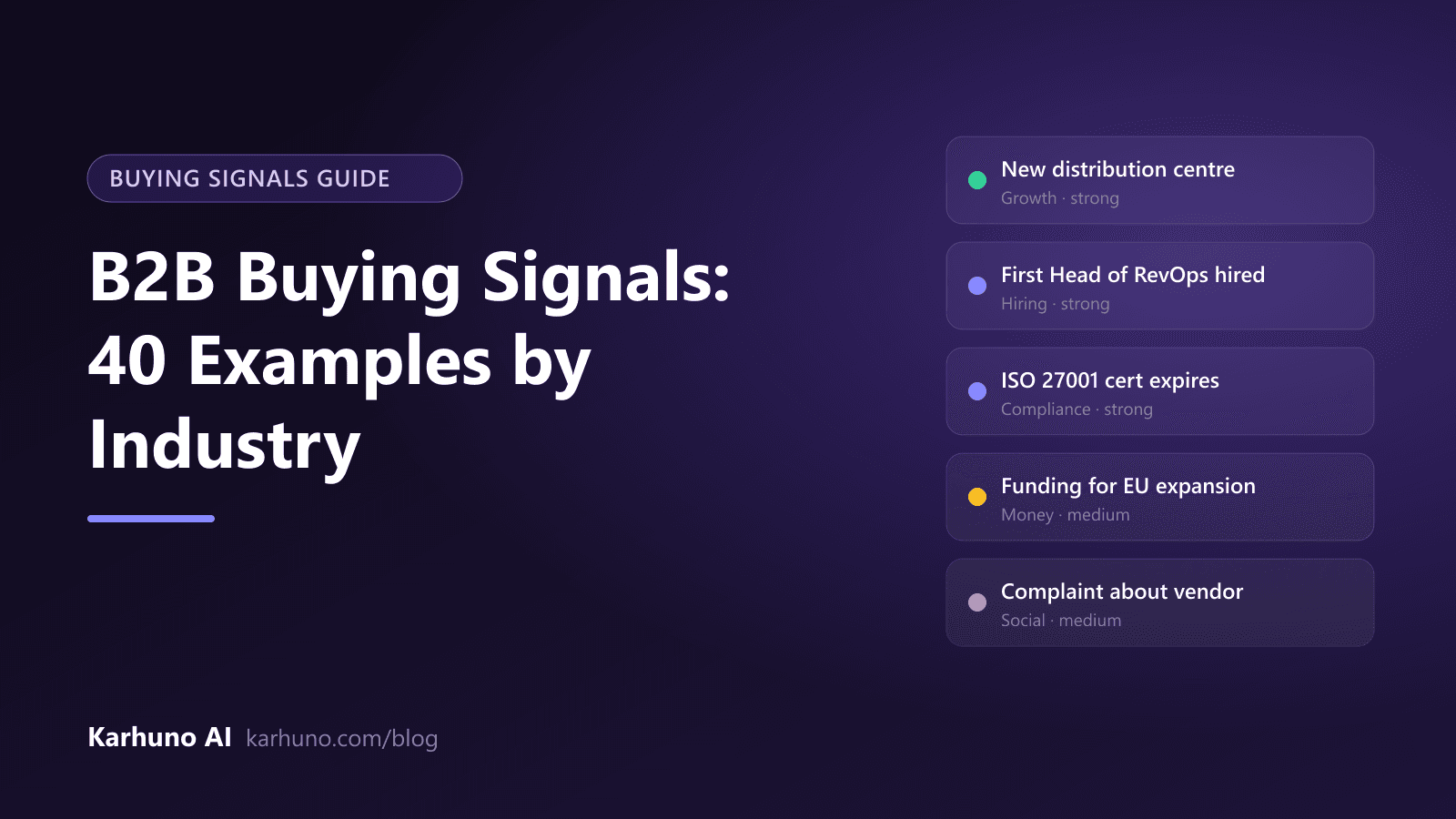
Three tests that separate a buying signal from noise
Most signal feeds fail for the same reason: they mix real events with trivia. Before an event goes on your list, it should pass three tests.
- You can verify it. There is a press release, a job post, a filing, a tender notice or a post with a date. If you cannot link to it, you cannot mention it, and it is probably a guess.
- It connects to what you sell. "They raised a Series B" is interesting. "They raised a Series B to open two fulfilment centres" is a signal if you sell to fulfilment centres.
- It starts a clock. The event forces a decision within a window you can name: before go-live, before the certificate expires, within a new executive's first quarter.
Events that fail the tests can still be useful for ranking accounts. They just are not a reason to write to anyone today. Once a signal passes, the next step is turning it into a conversation, which we cover in the signal-based selling playbook.
40 B2B buying signals, grouped by type
Each table shows what the signal usually means, who tends to own the decision, how long the window typically stays open and how strong the signal is on its own. Windows and strength are rules of thumb. Your market will shift them, so treat the tables as a starting map.
Growth and expansion signals
Growth events create purchases that did not exist last month. A new site needs equipment, systems, people and services, and most of it gets bought before the doors open.
| Signal | What it usually means | Who to contact | Typical window | Strength |
|---|---|---|---|---|
| New plant, warehouse or distribution centre announced | Equipment, systems, staffing and services for a site that does not exist yet | Operations or site director | Until go-live | Strong |
| Expansion into a new country | Local entity, payroll, legal, office space, local partners | Country manager or GM | First 6 months | Strong |
| New office opening | Fit-out, IT, security, facilities contracts | Facilities or IT lead | Before move-in | Medium |
| Acquisition completed | Systems integration and vendor consolidation | CFO, CIO or integration lead | First 100 days | Strong |
| New product line or service launch | New suppliers, tooling, marketing and channel partners | Business unit or product head | Around launch | Medium |
| Large customer contract announced | Capacity ramp-up to deliver it | Operations director | Weeks after the announcement | Medium |
| Building permit or zoning approval filed | Construction now, fit-out and systems later | Project or real estate director | Months before construction ends | Medium |
| New distribution or partnership deal | Integration, enablement, logistics changes | Partnerships or channel lead | 1 to 3 months | Medium |
Hiring and leadership signals
Job posts are public, dated and specific. They tell you what a company is about to build, and sometimes which tools it already uses.
| Signal | What it usually means | Who to contact | Typical window | Strength |
|---|---|---|---|---|
| First hire in a new function (first CISO, RevOps or sustainability lead) | A new budget with no incumbent vendors | The hiring manager, then the new hire after about 30 days | First 90 days of the role | Strong |
| Hiring spree in one department | The team is scaling and the current setup will not keep up | Department head | While roles are open | Medium |
| New C-level or VP appointed | New leaders review vendors and processes early | The new executive | First 3 to 6 months | Strong |
| Job post names a tool or competitor | Confirms the stack, or a migration if it asks for migration experience | Hiring manager or team lead | While the role is open | Medium |
| Job post for an admin of a system category (WMS, ERP, SIEM) | A system was just bought or is about to be chosen | Head of the function that owns the system | Weeks | Strong |
| Senior leader leaves | Existing vendor relationships lose their sponsor | The successor | After the successor starts | Medium |
| Hiring in a new city or country | An expansion that may not be announced yet | Regional or country lead | 1 to 3 months | Medium |
Funding and budget signals
Money on its own is a weak signal. Money with a stated purpose is a strong one, because the company has already told you what it plans to buy.
| Signal | What it usually means | Who to contact | Typical window | Strength |
|---|---|---|---|---|
| Funding round with a stated use of funds | Budget earmarked for something you can map to | The executive who owns that use | 6 to 18 months | Strong if the use matches |
| Public grant or subsidy awarded | Project budget, often with deadlines and reporting rules | Project lead | Grant period | Strong |
| Public tender or contract won | Delivery starts soon and may need subcontractors or new capacity | Delivery or project manager | Before delivery starts | Medium |
| Capex plan or debt financing announced | Large equipment or infrastructure purchases | CFO or operations | Months | Medium |
| Earnings call names investment priorities | Listed companies say where money goes next | The business unit named | Next 1 to 2 quarters | Medium |
| New fiscal year or budget cycle | Planning season for next year's spend | Budget owner | Planning weeks | Weak alone |
Compliance and regulation signals
Compliance deadlines are the most predictable signals there are. The date is known in advance and the company cannot ignore it.
| Signal | What it usually means | Who to contact | Typical window | Strength |
|---|---|---|---|---|
| Certificate expiring (ISO 27001, ISO 9001, IATF 16949) | Renewal audit, possibly a new certification body or consultant | Quality, compliance or security owner | Months before expiry | Strong |
| New regulation comes into scope (NIS2, CSRD, DORA, EU AI Act) | New controls, reporting and tooling | Compliance, risk or the function regulated | Before the deadline | Strong |
| Tender requires a certification the company lacks | They need it fast to stay eligible | Bid manager or compliance lead | Before the bid deadline | Strong |
| Audit finding, fine or regulator action made public | Remediation budget | Compliance or the area named | Weeks | Medium, handle with care |
| Security incident disclosed | Incident response, tooling, training | CISO or IT lead | After the first response | Medium, handle with care |
| Hiring a DPO, compliance or risk role | A compliance programme is being built | The hiring manager | While the role is open | Medium |
| Entry into a regulated market (medical, finance, defence) | Certifications, audits and new processes | Head of quality or regulatory | Before market entry | Strong |
Technology and vendor signals
Technology signals tell you when an incumbent vendor is weakest. That is usually the only time a switch makes sense to the buyer.
| Signal | What it usually means | Who to contact | Typical window | Strength |
|---|---|---|---|---|
| Current product reaches end of life or end of support | A forced replacement decision | Owner of that system | Before the support date | Strong |
| Migration announced (cloud, ERP, CRM) | Integration, data, training and adjacent tools | Project lead or CIO | During the project | Strong |
| Tech stack change detected on the website | A tool was added or removed | Marketing ops, IT or the owning team | Weeks | Medium |
| Public complaint about the current vendor | Switching cost suddenly looks worth paying | The person who posted, or their lead | Days to weeks | Strong |
| Their vendor raised prices or was acquired | Contract review at the next renewal | Procurement or the system owner | Before renewal | Medium |
| Website or e-commerce platform rebuild | Agencies, hosting, payments, integrations | Digital or e-commerce lead | During the project | Medium |
Buying signals by industry
The same event means different things to different sellers. A new distribution centre is a top signal for a WMS vendor and irrelevant for an HR software company. These are the signals that matter most in the industries we work with.
B2B SaaS
Leadership changes, first hires in a function your product serves, funding with a stated go-to-market use, stack changes and public complaints about a competitor. A new VP of Sales who joined six weeks ago and is hiring SDRs is close to the ideal SaaS signal. More in our SaaS use case.
Logistics and warehousing
New DC and warehouse announcements, building permits for logistics real estate, WMS or automation job posts, new 3PL contracts and expansion into new regions. These signals are unusually concrete because they come with square metres and go-live dates. See the warehouse signals case study and our guide to lead generation for logistics companies.
Manufacturing
New production lines, plant expansions, capex announcements, quality certification renewals, supplier changes and hiring for maintenance or process engineering. Public grants for modernisation are a strong and often overlooked signal in the EU. See the manufacturing use case.
Cybersecurity and compliance
Expiring ISO 27001 certificates, tenders that require a certification, NIS2 or DORA coming into scope, first CISO or DPO hires and publicly disclosed incidents. The deadline is usually public, which makes these some of the most reliable signals there are. Full walkthrough in how to find companies that need ISO 27001.
Industrial automation
Greenfield sites, retrofit projects, labour shortage posts from plant managers, robotics or controls engineer hiring, and end of support for legacy control systems. See the industrial automation use case.
Freight and transport services
New facilities, shifts in sourcing regions, new product launches that change shipping lanes, and complaints about current carriers. Our guide on how to find shippers as a freight broker shows how these turn into shipper conversations.
How to prioritise and stack signals
When a feed produces more accounts than your team can work, rank them on three questions:
- How specific is it to you? An event that names your category beats one that only implies growth.
- How well does the account fit? A strong signal at a company outside your ICP is still a long shot.
- How fresh is it? Windows close. A two-week-old tender is worth more than a four-month-old funding round.
Stacked signals deserve the top of the list. A warehouse announcement on its own is good. The same announcement followed by a job post for a WMS administrator and a LinkedIn post from the site director about hiring is a company in the middle of a buying decision. Two medium signals that point the same way often beat one strong signal on its own.
Also watch for negative signals: a competitor just signed a multi-year contract, a hiring freeze, layoffs, or an acquisition that moves decisions to a parent company abroad. These belong in the same feed, because they save your team from chasing dead accounts.
What changes when you sell in Europe
Most signal advice is written for the US market. Three things work differently in Europe.
- Language. Many of the best signals are published in German, French, Dutch, Italian, Polish or Finnish, on local news sites and regional business registers that English-only tools miss.
- Public procurement. EU tenders are published on TED and national portals. They are some of the clearest signals available because budget, specs and deadlines are all public.
- Data protection. Company events are generally not personal data, but the people you contact are. GDPR and national e-marketing rules shape how you reach out. We cover this in GDPR and signal-based prospecting in the EU.
For a wider view of the regional data gap, see our guide to intent data in Europe.
How to track buying signals
For one narrow niche, a person with an hour a day can cover a lot by hand:
- News alerts for facility openings, expansions and acquisitions in your target regions
- Job boards filtered for the roles that reveal a new function or a new system
- Tender portals such as TED for public procurement
- Certificate registries and supplier directories for expiry dates
- LinkedIn, Reddit and X for requests and complaints. Our LinkedIn buying intent signals and Reddit monitoring workflow show how
It stops scaling once you cover several countries, languages and signal types. Then the work is less about finding events and more about filtering them: checking fit, removing disqualified accounts and finding the right person.
That is what Karhuno does. You describe your ICP and the events that matter to you, and Karhuno monitors the web, LinkedIn, tenders and local news in European languages. Each opportunity arrives with the source link, account context, disqualifier checks and the decision makers to contact. Plans start at $299/month for 100 deal opportunities, with a 7-day free trial.
Want to compare tools first? See our guides to ZoomInfo alternatives, Apollo alternatives without credits and Clay alternatives.
FAQ
- What is a buying signal in B2B sales?
- A buying signal is a verifiable event at a company that makes a purchase in your category more likely in the near future, such as a new facility, a first hire in a new function, a stated use of funding or an expiring certificate. It tells you who to contact, when, and what to talk about.
- What are examples of buying signals?
- Common examples include a new warehouse or plant announcement, expansion into a new country, a first CISO or RevOps hire, a new executive, a funding round with a stated purpose, a certificate about to expire, a new regulation coming into scope, a vendor's end of support, and a public request for tool recommendations.
- What is the difference between buying signals and intent data?
- Intent data usually measures research activity, for example an account reading more content on a topic than usual, and turns it into a score. A buying signal is a specific event with a source you can check. Intent data helps rank accounts; buying signals give you a reason to reach out and something concrete to say.
- Which buying signals are the strongest?
- The strongest signals combine a hard deadline with a direct link to what you sell: a site going live, a certificate expiring, a regulation taking effect, a product reaching end of support, or a first hire in a function that buys your category. Social signals are fast but should be confirmed by a second, harder signal.
- How do you track buying signals?
- You can track them by hand with news alerts, job boards, tender portals, certificate registries and social listening, which works for one narrow niche. Across several countries and languages it becomes a full-time job, which is why teams use signal platforms such as Karhuno that monitor sources, qualify events against the ICP and attach the right contacts.
- Is it legal to use buying signals for outreach in Europe?
- Company-level events are generally not personal data. Contacting a person about them is, so GDPR applies, usually on the basis of legitimate interest, alongside national e-marketing rules that differ by country. See our guide to GDPR and signal-based prospecting for the details.
Social and engagement signals
Social signals are the fastest and the noisiest. Treat them as a reason to look closer, then confirm with something from the groups above.